
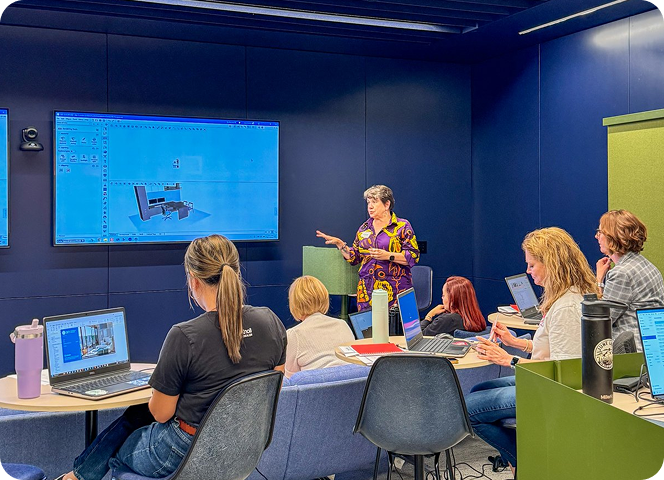
You do not need to arrive at a training session with all the right words. “I keep getting stuck here” is a perfectly useful beginning. What helps is being able to show where “here” is and explain what you were hoping to do.
Before the session, think about a task that takes more effort than you would like. Perhaps you are uncertain about a step, repeating work, or unsure what to check before moving on. Write that situation down in plain language.
A session becomes easier to connect to your work when you have a real question to carry into it. The question can change as you learn. It is there to give you a starting point, not a test to pass.
Trying to write down everything can leave little room to watch, think, or practice. Instead, look for the parts you will want to understand when you return to your own work.
Note the purpose of the task, an important choice, and any check that tells you whether the result makes sense. If a term is unfamiliar, write it down and ask what it means in this situation.
Keep unanswered questions in a separate space. That makes it easier to come back to them without losing your place. If you bring a project example or screenshot, remove confidential client or project details unless you have permission to share them.
At the end of a session, take a moment to identify the part you want to practice first. Keep it small enough to describe in a sentence. “Review everything” is difficult to begin; “repeat this task in a practice file” is more concrete.
Write down one question that remains. Add enough context that you will recognize it later: the task, the step, and what you expected to happen.
Your notes do not have to become a perfect manual. They only need to help you return to the learning with a little more direction than you had before.